

Budgets are rarely lost where the invoices are. They are lost in the days between a question being asked and an answer arriving, and nobody is counting those days.
Ask any project team what blew their budget and you will hear about material prices, labour shortages, or a subcontractor who underperformed. Those are legitimate factors. But they are rarely where the losses began.
The most expensive cost in construction is information that arrives too late to act on.
A drawing is revised to Revision C while the site is still building to Revision B. A material approval remains unanswered until the delivery date has already passed. A verbal agreement that nobody wrote down surfaces eighteen months later as a claim.
None of these are execution failures. They are information failures, and they begin earlier than most people think. Not when somebody forgets to send an email, but when nobody decides that the information needs to be recorded in the first place.

Why Construction Information Arrives Late: Two Causes
The first is that it was never turned into something anyone could track. The issue lives in a chat group of forty people, in one foreman’s camera roll, or in a sentence said during a site walk. It has no number, no owner, and no status.
Things without those three properties do not necessarily disappear. They simply go uncounted.
And what is uncounted cannot be accounted for.

The second is that it was recorded, but nobody was counting the days. The approval was raised. It reached the right person. Then it sat there for eleven days. Nobody was necessarily at fault, because nobody knew that eleven days had passed.
Everything that follows is an answer to one of these two problems: make the information trackable, and make its age visible.
Every RFI, Approval and Inspection Carries Two Dates
Every item that needs an answer, such as a question from the site, an approval, an inspection, an instruction to put something right or a safety observation, carries two dates:
The date it was due, and the date it was actually answered.
That distinction sounds administrative, but is actually the difference between a system that stores information and one that changes behaviour.
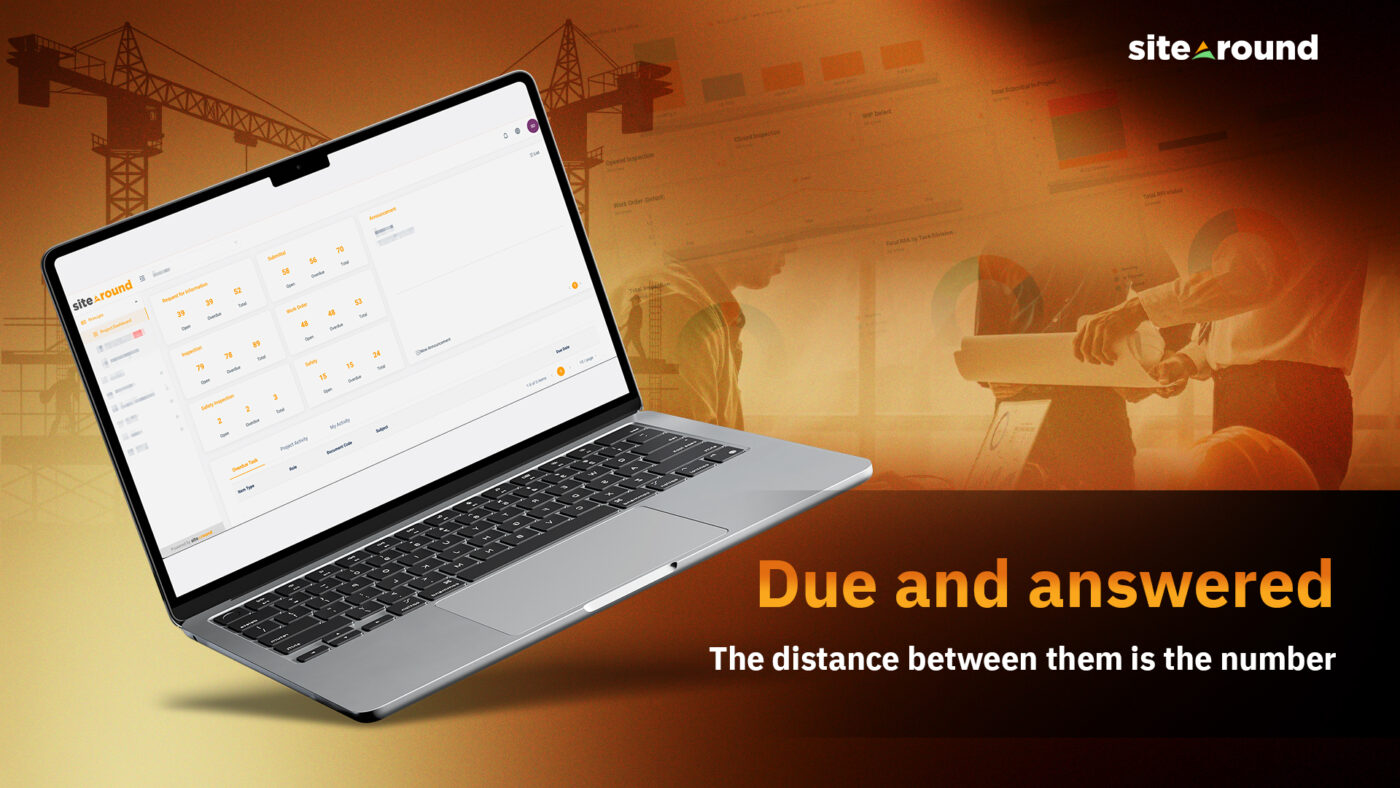
When both dates exist on every step, lateness stops being a feeling that somebody raises in a meeting and becomes a number that can be counted, sorted, and acted on. The project’s front page is no longer simply a list of documents. It becomes a picture of the work itself, what is open, what is overdue, and where time is being lost.
The effect on people is immediate and worth stating plainly. An item sitting in a chat thread is easy to overlook. An item with an owner, a deadline, and a visible age is much harder to leave unattended.
The platform does not decide whether eleven days is too long. That depends on the item, the project, and the team’s judgement. What is avoided is the situation where nobody noticed that eleven days had passed.
The Construction Record That Survives a Dispute
Three things make a record useful when somebody later needs to prove what happened.
Before-and-After Defect Photos as One Record
When an inspection finds something wrong, the engineer photographs the condition and marks the defect directly on the photograph — the circle and the cross go onto the image, not into a message describing it.

That photograph becomes the starting point for a work order with a named assignee and a date by which it must be answered. The subcontractor responds on the same record with a photograph of the repair. The manager approves it or sends it back.
When the record closes, what remains is a pair: the condition before and the condition after, each carrying the name of the person who submitted it and the minute it was taken.
Drawing Revision Control and Version History
A document that is revised remains the same document at its next version, with a record of what changed and when. The alternative, a new file each time with the revision buried somewhere in the filename, is how three live versions of the same sheet end up in circulation at once, and how somebody eventually builds to the wrong one.
Records Linked to Project Location
Records are not organised by inbox or by sender. They are connected to the part of the project they concern. Open a location and you can see what happened there: the questions raised, the work inspected, the defects closed out, the safety observations recorded.
That last one matters more than it first appears. Eighteen months later, the question is almost never who sent the email about this?
It is: What happened at this point, and can we show it?
A record organised by sender answers the first question. A record organised by place answers the second.

The Part Nobody Mentions When You Buy Construction Management Software
Everything above rests on an assumption that vendors rarely say out loud:
Somebody has to decide, in advance, what needs to be recorded, and in what form.
That decision is not simply an implementation detail. It is the whole thing. A field you define is a question you will be able to answer in two years. A free-text box is not.
If an inspection form captures the reason a piece of work failed as a choice from a defined list, then at the end of the year you can see which reason occurred most often and investigate the cause. If the same information goes into an open comment box, you may end up with three hundred lines of prose describing the same recurring problem in forty different ways.
Why Your Inspection Forms and Approval Workflows Must Be Your Own
An inspection form for a power plant is not an inspection form for an office building. A form written into a client’s contract cannot simply be reshaped around the assumptions of a software vendor. Work carried out under a regulatory regime may require records whose content is not negotiable.
A platform that ships fixed forms is asking you to adapt your process to someone else’s assumptions. A platform where you define the documents, fields, checks, and approval routes lets the system follow the process you already have — and puts the same visibility of ownership, deadlines, and elapsed time into that process.

This is worth being honest about, because it is not free. Defining what must be recorded means somebody has to sit down at the start of a project and think about what the team will need to know later. That work does not disappear when you buy a system with all the decisions already made. It has simply been made by somebody else, for a project that is not yours.
The choice is not whether to do it. The choice is whether to do it at the start, or to discover, at the moment you need the answer, that nobody ever collected it.
What Actually Changes With Better Document Control
It is worth being precise about the claim. Adopting a platform does not make site problems disappear. Concrete still fails its test. Materials still arrive late. Designs still change.
What changes is when you find out.
A problem discovered on the day it occurs is a scheduling conversation. The same problem discovered six weeks later is a rework cost, a delay claim, and an argument about who pays.
The event is identical. The cost is not.
In construction, the speed at which you learn about a problem can translate directly into margin.

But there is a condition. You can only learn about the things somebody decided, at the start, that you needed to know.
Want to see how this could work on your projects? Talk to the Sitearound team.